Electric vs Diesel Tractor Testing: What Changes Without an Engine
Manufacturers coming to electric tractors from diesel often expect a completely different testing world. In practice most of it is familiar: the same institute, the same headline performance tests, and the same reports, subsidy rules and validity periods. What changes is what sits behind the drawbar: a battery and motor instead of an engine, and the standards that come with each.
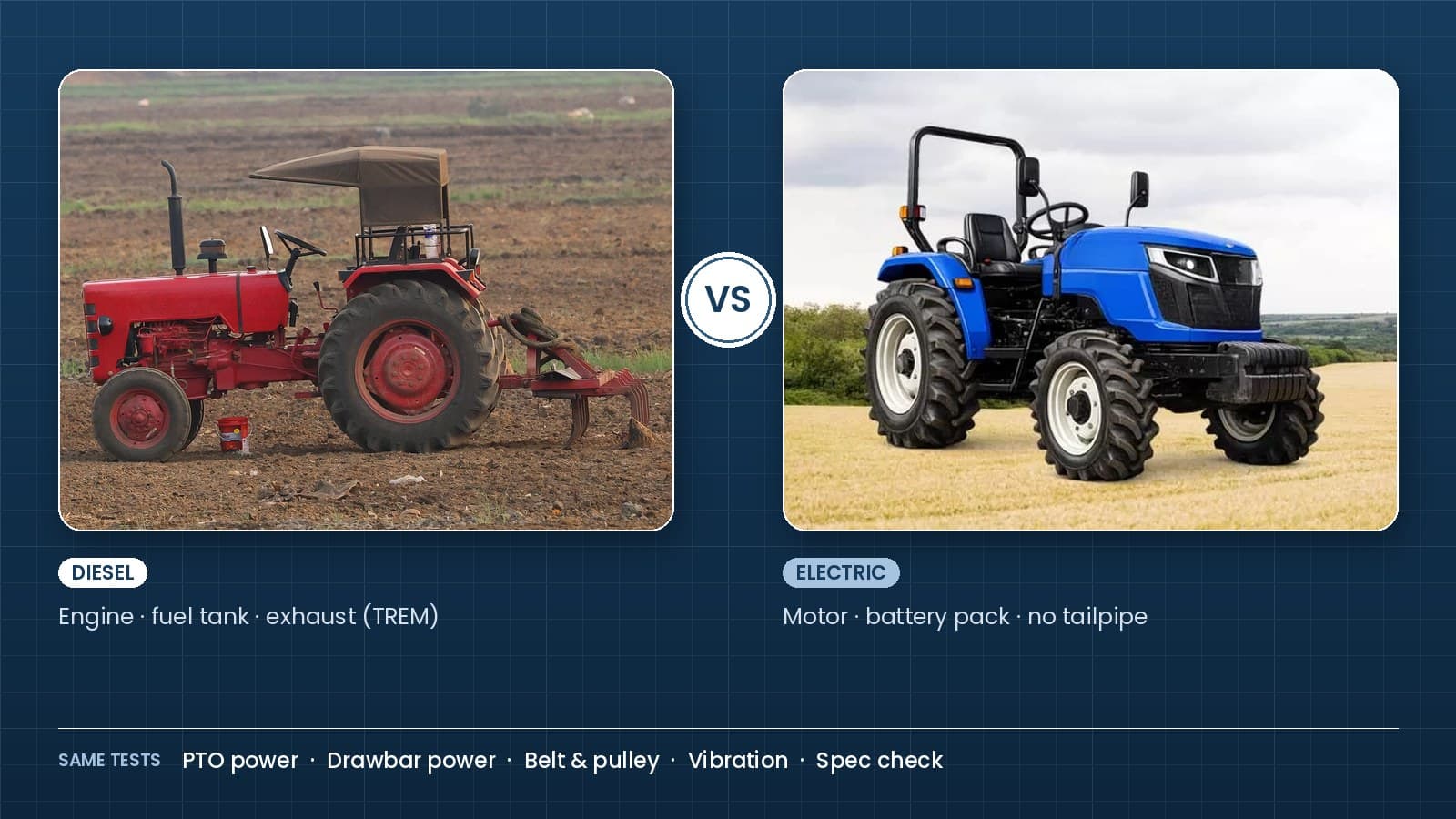
The side-by-side
| Diesel tractor | Electric tractor | |
|---|---|---|
| Test code | IS 5994, Agricultural tractors — Test code | IS 19262:2025, Electric Agricultural Tractors — Test Code (built on IS 5994:2022) |
| PTO, drawbar, belt and pulley | Yes | Yes, the same headline tests |
| Vibration measurement | Yes, with dedicated vibration standards in the FAD 11 family | Yes, named in the IS 19262 scope |
| Powertrain standards | Engine tests within the tractor code family | Automotive Industry Standards for electric vehicles, adapted for farm use |
| Exhaust emissions | TREM emission norms, tested on engine cycles | No tailpipe emissions at the farm |
| Benchmarks | Built on decades of tractor standards and test data | Electric-specific acceptance criteria expected to develop from IS 19262 test data |
| Institute | CFMTTI Budni | CFMTTI Budni, which has tested electric tractors since 2021 |
| Testing time limit | 75 working days (from 15 Aug 2022) | 75 working days, the same tractor limit |
| Subsidy eligibility | Only tested equipment is eligible under SMAM | Same rule |
What stays the same
The farm-performance tests. IS 19262:2025 covers PTO power, drawbar power, belt and pulley performance, vibration measurement, specification verification and inspection of components and assemblies.[1] These are the tests that make a tractor a tractor, and they are why the electric code builds on IS 5994:2022 rather than starting from scratch. A buyer comparing an electric model with a diesel one gets measurements taken the same way.
The institute. CFMTTI Budni handles both. It tested the first-ever electric tractor at the institute in 2021,[2] and it contributed to IS 19262:2025.[1] Our first electric tractor test post covers that story.
The process and the rules around it. The tractor testing time limit of 75 working days, in force since 15 August 2022, doesn't distinguish by fuel.[3] The SMAM rule that only tested equipment is eligible for subsidy applies to both.[7] So do the tractor sample size (5 units) and report validity (3 years for the first commercial test, 5 years for each Batch Test after that).
What changes: the powertrain
A diesel tractor's power comes from an engine, and the tractor code family has standards built around measuring it. An electric tractor uses motors and a battery pack. The BIS release describes electric tractors as using "electric motor(s) powered by battery packs, instead of conventional diesel engines".[1]
That is why IS 19262:2025 draws on "relevant Automotive Industry Standards developed for electric vehicles, suitably adapted for agricultural applications" as well as the tractor code.[1] The release does not name which AIS documents are used, and we won't guess. Your copy of the standard lists its normative references.
What changes: emissions
This is where the two diverge most clearly.
Diesel tractors are subject to the TREM emission norms for agricultural tractor engines, and type-approval includes emission compliance on engine test cycles. The next stages are now arriving. MoRTH issued a notification on 6 March 2026 on implementing the TREM norms, phased by engine power band.[4] The ICCT describes the TREM V stage as aligning Indian non-road norms for agricultural tractors with EU Stage V.[5] Secondary summaries of the phasing disagree on exact dates, so take the dates for your power band from the gazette notification itself.
Electric tractors have no engine exhaust. The BIS release notes that an electric tractor "eliminates tailpipe emissions at the farm level", and also points to significantly lower noise and no operator exposure to exhaust fumes.[1] Engine emission cycles simply have nothing to measure.
What changes: benchmarks
Diesel tractors have decades of standards and test data behind them. For electric tractors, the BIS release says the data generated under IS 19262:2025 "would also assist in the future development of acceptance criteria and conformity assessment schemes specific to electric tractors".[1]
In practice, the measurement method is settled and the electric-specific benchmarks are still being built. Manufacturers testing now are contributing to that data. A thoroughly prepared first submission is good engineering and also helps set the reference point for the category.
A practical checklist for diesel makers going electric
- Keep your tractor-testing playbook. Documents, sample size, the draft-report stage and validity planning all carry over. Our electric tractor testing guide covers the full route.
- Add IS 19262:2025 to your standards library alongside IS 5994:2022, and read its EV-standard references. The IS 19262 explainer walks through it.
- Rework your specification sheet for the electric powertrain. Specification verification is in the IS 19262 scope, so declare motor and battery details you can stand behind.
- Settle the type-approval scope with CFMTTI Budni early. It is the one area where you should get the institute's answer rather than rely on diesel habits.
- Price subsidy by PTO HP, as the SMAM bands do. See Electric tractor subsidy: the test report comes first.
Where we come in
Mapping a diesel testing playbook onto an electric tractor, and finding the few points where it doesn't carry over, is the work test process guidance covers. AgPro doesn't test tractors; CFMTTI Budni's engineers do. We help you arrive with the right code, the right documents and the right questions already answered.
Sources
- Union Minister Shri Pralhad Joshi released Indian Standard for Electric Agricultural Tractor (IS 19262:2025) — Press Information Bureau, Ministry of Consumer Affairs, Food & Public Distribution, December 28, 2025
- Central Farm Machinery Training & Testing Institute, Budni (MP) tests the first-ever electric Tractor in the Institute — Press Information Bureau, Ministry of Agriculture & Farmers Welfare, April 29, 2021
- Time limit slashed for the testing process of tractors used for farming — Press Information Bureau, Ministry of Agriculture & Farmers Welfare, August 5, 2022
- MoRTH notified regarding the Implementation TREM Emission (secondary summary of the 6 March 2026 notification) — TeamLease RegTech
- India's tractor exports and relative emission standards (working paper) — International Council on Clean Transportation, Aug 2025
- FAD 11 — Agricultural Tractors and Power Tillers: list of Indian Standards — SRFMTTI, Garladinne (retrieved 14 September 2026)
- Guidelines of Sub-Mission on Agricultural Mechanization (SMAM), revised 2020-21 — Department of Agriculture & Farmers Welfare
Frequently asked questions
- The headline performance tests are shared. IS 19262:2025, the electric tractor test code, covers PTO power, drawbar power, belt and pulley performance, vibration, specification verification and component inspection, and it draws on IS 5994:2022, the tractor test code. The differences are in the powertrain: the electric code adapts Automotive Industry Standards written for electric vehicles, while a diesel tractor also goes through engine emission compliance.
- Tractor emission norms (TREM) and their test cycles are set for engines. An electric tractor has no engine exhaust: the BIS release on IS 19262:2025 notes that electric tractors eliminate tailpipe emissions at the farm level. How CMVR type-approval applies to a particular electric model is something to confirm with CFMTTI Budni for that model.
- TREM is the series of emission norms for agricultural tractor engines. On 6 March 2026 MoRTH issued a notification on implementing the next TREM stages, phased by engine power band. Because the norms apply to engine exhaust, the direct burden falls on diesel tractors. Check the gazette notification for the dates that apply to each power band.
- Both go through CFMTTI Budni, the institute at the centre of tractor testing and type-approval in India. It tested the first-ever electric tractor at the institute in 2021, and its CMVR Test Laboratory has held NABL accreditation since 30 March 2021.
- The 75-working-day time limit introduced from 15 August 2022 applies to the testing of agricultural tractors, and the announcement does not separate electric from diesel. Confirm the current timeline for your model with the institute.